It’s 5 a.m. in Đồng Văn when the first Honda Waves wake the alleys. You pull on a fleece (even in summer, 1,500 meters up will not forgive you), and head for the Mã Pí Lèng pass. You’re not up this early by accident. Hà Giang doesn’t photograph itself: it surprises you, in those minutes when the blue mist breaks and reveals the Tu Sản canyon 800 meters below.
There’s no Eiffel Tower here, no starred spot on Google Maps. Just steep roads, villages floating in the clouds, and light that changes so fast you’re better off with manual settings than auto. You don’t need to be an expert. Just be able to keep your camera steady in the cold, accept that the best shot often comes after missing three, and remember the landscape is never truly empty, it’s inhabited.
Mã Pí Lèng: the king of passes
The pass looks down on the
Nho Quế River in a cathedral-like silence. At dawn the valley stays dark while the ridges catch fire. Then the light slowly comes down and the water shifts from emerald to gold. If you have a tripod, try f/8, ISO 100, and use a long exposure to smooth the surface. If not, don’t feel bad about raising the ISO: what matters is the line of light on the cliff, not perfect sharpness.
Note: a neutral density (ND) filter may help if the sun is already a bit high, because even at ISO 100 the emerald water can overexpose quickly.
Real tip? Turn around. Side-lit rock faces show textures that front light flattens. And when you hear an engine behind you, wait: the silhouette of a motorcycle on a switchback often beats the sunrise itself.
Quan Bạ: the golden hour at dusk
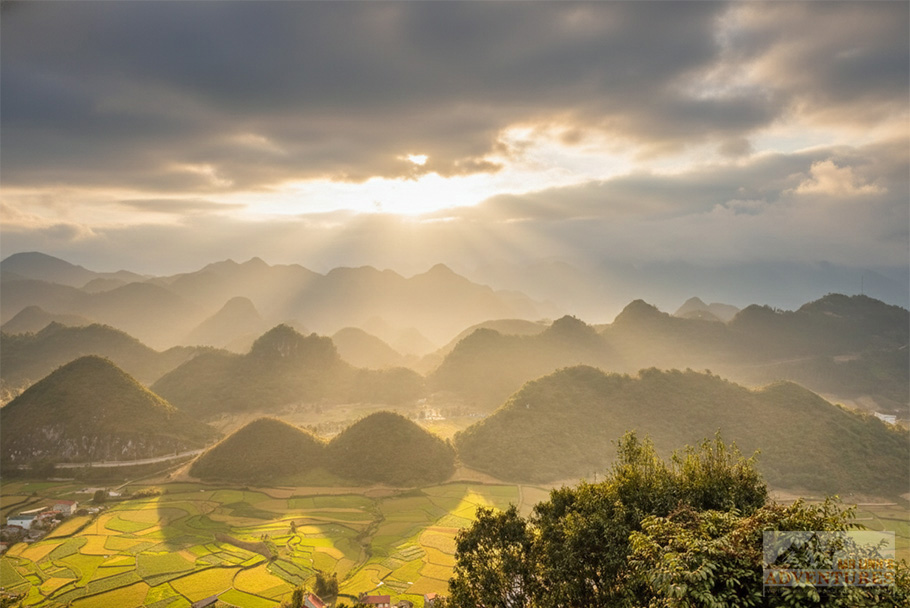
Further south, the
Quan Bạ pass saves its minutes for sunset. The
Twin Mountains, two rounded hills linked to a local legend about a fairy, catch the light like natural spotlights. Mist rises from the valley, creating layers of color: bright orange above, blue-gray over the rice fields below.
Look for higher ground to stack terraces in the frame. A lone tree, a parked motorbike, a farmer heading home… these elements give scale. The sky will be brighter than the land: slightly underexpose to protect highlights — you can recover shadows later.
Lũng Cú: the end of the road
The flag tower, the country’s northernmost point, works at any hour. At sunrise, low light sculpts Hmong village roofs; at sunset, the hills wear purple drapery. Avoid the main platform at peak times. A ten-minute climb to the neighboring hill gives the same view without the crowd.
Yên Minh: the water mirrors
Between passes, the flooded rice paddies around Yên Minh and Du Giá reflect the sky like a second window. There are two windows each year: May-June, before the summer rice is planted, and September-October for some late terraces. At sunrise and sunset, the still water becomes an immersion in saturated orange. Find a low wall or bank to frame multiple terrace levels. Put the horizon near the center, sky and water will do the symmetry for you.
When to go
Autumn (September-November) is the prime season: golden rice, buckwheat flowers in mid-October, clear skies. Summer gives vivid greens but unpredictable storms. Winter, cold and clear, offers crisp light if you’re willing to freeze your fingers on the lens.
Photographing the Hmong, Dao, Lô Lô: look first, image second
Hà Giang is not an open-air museum. The colorful costumes you see, Hmong indigo, Dao red, Lô Lô embroidery, belong to real lives, not props.
Before raising your camera, follow four simple gestures.
1) Make contact. A smile, a "Xin chào," an exchanged look.
2) Get consent. Sometimes it’s unspoken, sometimes explicit: if a Hmong woman turns away, that’s not an invitation.
3) Share the image. Show the photo on your screen and let it be seen.
4) Preserve dignity. Don’t offer candy for a portrait, and avoid paying for a forced smile. Those exchanges demean more than they compensate.
The best portrait often comes after five minutes of conversation, when your camera stops being a weapon and becomes a reason to talk. And sometimes the best picture is the one you don’t take — because the moment was too private, the person said no, or you chose to listen instead.
Final shot
Hà Giang rewards those who shift their rhythms. But after the click, put the camera away. Drink the tea offered in Pa Vì. Listen as the silence returns when the engines die. The best image is often the one you keep in your head, of standing in the cold, watching the light at work.